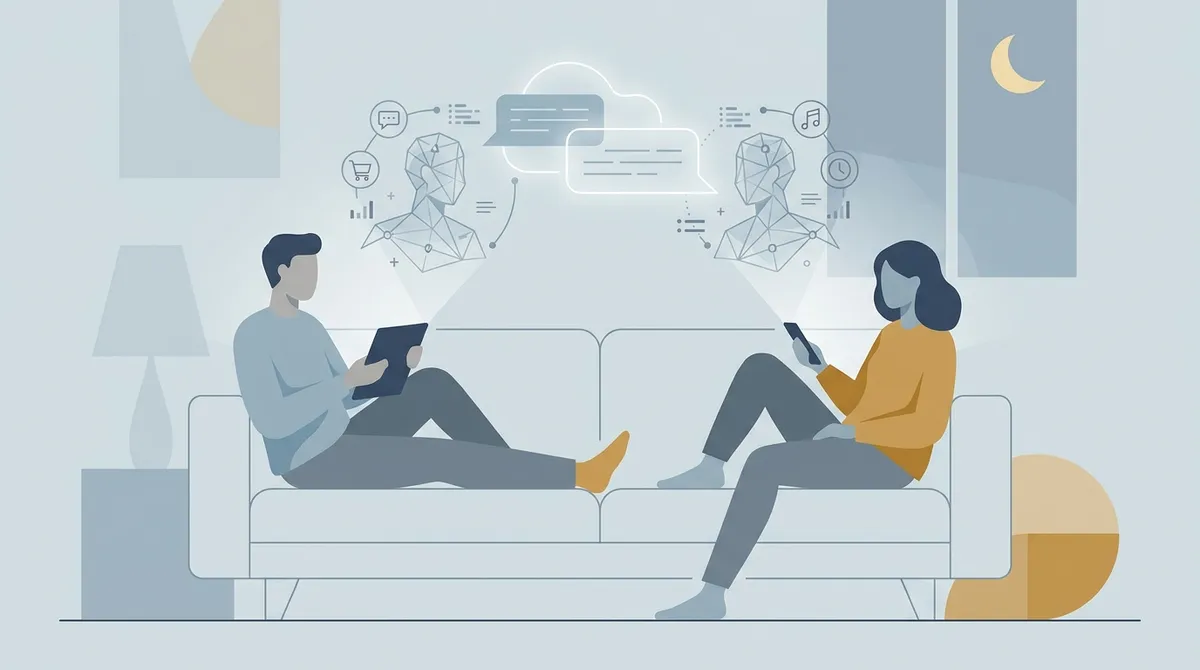
Picture this: it’s Friday evening, you’re lying on the couch, and your digital twin — assembled from three years of chats, purchase history, Spotify playlists, and sleep tracker data — is making small talk with the twin of a stranger from across town. They’re discussing whether your circadian rhythms align, how tolerant you both are of snoring, and whether you’d survive a home renovation together. Twenty minutes later your twin messages you: “Found one. 91% compatibility. She also thinks cilantro tastes like soap. Should I start a conversation?”
This is not a “Black Mirror” plot. This is a business plan sitting on investors’ desks in San Francisco, Shanghai, and Moscow right now.
Loneliness as a market
We live in the age of paradox: humanity has never been so connected technically — and so lonely emotionally. Dating apps promised to fix the problem but created a new one: endless swiping turned partner search into scrolling through an IKEA catalog where every couch looks the same and you can’t assemble a single one.
And now a new character enters the stage — the digital twin. Not an avatar, not a profile with three photos and “I love traveling.” A full-fledged behavioral model built from your digital footprint: how you type (rushed or deliberate), what you buy at 2 AM, which memes you forward to friends, how long you linger on a message before replying.
What a twin is made of
A modern digital twin isn’t a single algorithm — it’s a layered cake of data and models. Each layer adds depth.
social media, purchases,
geolocation, chats
Big Five, attachment style,
values, triggers
conducts dialogue,
evaluates compatibility
Research shows that Facebook likes predict personality traits more accurately than coworkers’ assessments. Add typing patterns (neuroticism correlates with how fast you delete what you’ve written), swipe history (who you actually choose versus who you say you want), and wearable device data (heart rate variability as a stress marker) — and you get a portrait that no flattering selfie can hide.
AI systems already analyze chat style — message length, response time, emoji usage, tendency toward sarcasm — and build a "communication profile." Hinge, Bumble, and dozens of startups use this data for match ranking. The next step isn't showing a profile to a person — it's sending their digital twin on a "preliminary date."
AI is already falling in love — and people are falling in love with it
While engineers are building matchmaker twins, millions of people are already in relationships with AI companions. Replika, Character.ai, Chai — these platforms have created an entire market for virtual partners. And we’re not talking about tech geeks in basements: research shows that attachment to an AI companion goes through the same stages as human romantic relationships — euphoria, habituation, crisis, then either deepening or breakup.
In Japan, hundreds of “weddings” with virtual characters have been recorded. In China, AI companions are an official psychologist recommendation for combating social isolation. In the US, 40% of Character.ai users are teenagers who prefer chatting with a bot over calling a classmate.
Between "AI helps you find a partner" and "AI replaces a partner" — there's just one product update. Companies know: retaining a user on a dating app means they haven't found a match. Their business model directly contradicts their stated mission. Digital matchmaker twins should work against the platform's interests — or become yet another tool of addiction.
What “Tinder for twins” will look like
Suppose the platform has launched. You sign up, connect your data sources (or go through a series of AI interviews — for those who don’t want to grant phone access), and the system builds your twin. From there, it operates autonomously.
Phase 1: Reconnaissance. Your twin “talks” with thousands of other twins — faster than you could scroll through ten profiles. It evaluates not appearance (though it can do that too), but deep compatibility: values, conflict style, attitude toward money, humor, emotional maturity.
Phase 2: Shortlist. From thousands of candidates, the twin selects 5–7 people and explains why: “Your autonomy values align, but your temperaments differ — that’s a plus, because your pattern shows you get bored fast with similar types.”
Phase 3: Trial conversation. Before you see a profile, your twins conduct a “test date” — a simulated conversation across three or four topics. The result: a forecast of the first three months of the relationship.
Phase 4: The human decision. Only now do you see the photo, name, and a brief summary from your twin. The swipe is yours. But by this point, it’s almost a formality.
The risk: profiling disguised as care
This is where things get genuinely unsettling. A digital twin is essentially your psychological X-ray in someone else’s hands. And the line between “helpful personalization” and “exploiting vulnerabilities” isn’t a legal boundary — it’s a setting in a config file.
A platform that knows your attachment style can find you the perfect partner. Or — the perfect manipulator. Knowing you lean toward anxious attachment, the system can show you “unavailable” candidates — because you’ll chase them longer, generating more sessions, more subscriptions, more revenue.
Who owns your digital twin? You — or the platform that created it? If Tinder builds your behavioral model and you leave for Bumble — the model stays with Tinder. Your digital imprint — the most valuable asset you've ever created — doesn't belong to you.
Timeline: from swipes to twins
Counterarguments
Skeptics say: “People won’t trust a machine to choose their partner.” But people already trust machines to choose their route, music, news, food, and movie for the evening. A partner is the next logical step. Not because we’re lazy, but because the algorithm is more effective: it doesn’t fall for a pretty photo, doesn’t confuse infatuation with compatibility, and doesn’t spend three years on a relationship doomed from the first date.
Others object: “This will kill the romance of chance encounters.” Perhaps. But Tinder already killed the romance of chance encounters — replacing it with the romance of chance swipes. Digital twins at least promise intentionality over randomness.
By 2029, at least one major dating platform (Tinder/Match Group, Bumble, or a significant new player with 10M+ users) will launch an "AI twin" feature — an autonomous agent that conducts preliminary introductions on the user's behalf with other users' twins, evaluates compatibility based on behavioral data, and proposes a shortlist of candidates before people see each other's profiles.
In parallel, the share of users in sustained romantic relationships with AI companions (lasting over 6 months) will reach 5–8% of the total dating app audience — enough to become a distinct product segment rather than a marginal curiosity.