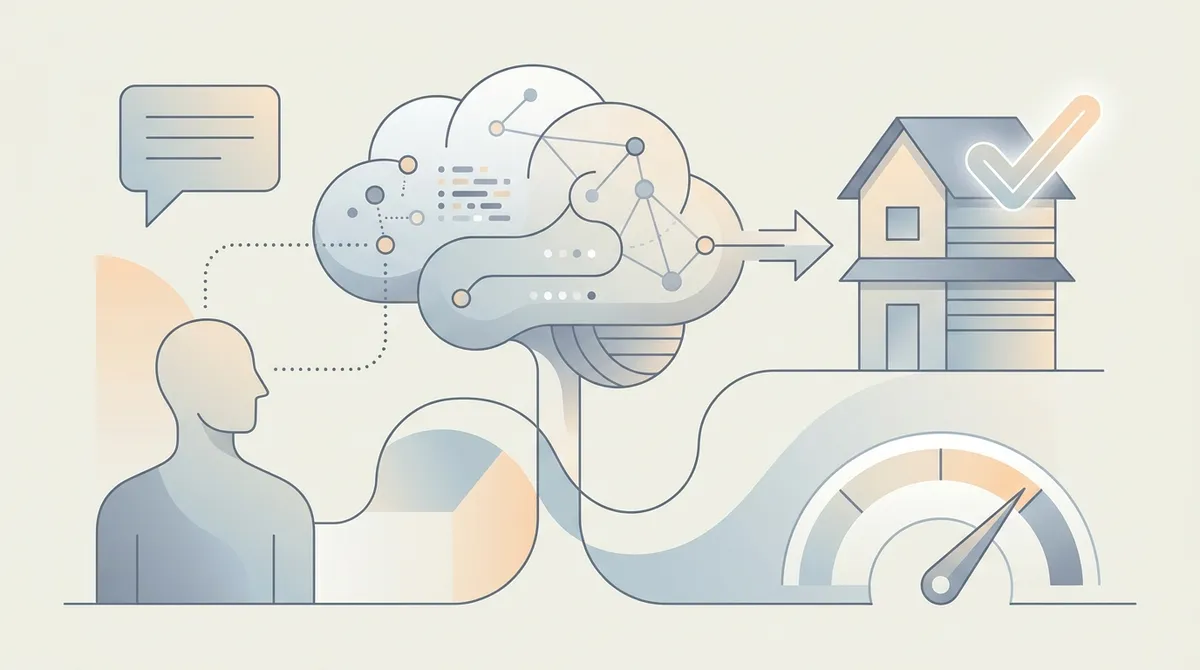
Imagine: you apply for a mortgage. The bank approves you in four minutes — not because it checked your income and credit history, but because it analyzed eight months of your conversations with an AI assistant. You never once asked “how to file for bankruptcy.” You twice asked for help with budgeting. You didn’t google symptoms of depression. You’re a reliable borrower. Welcome to your new home.
Your neighbor down the hall got rejected. His prompts showed an “unstable behavioral profile.”
You can embellish your resume. Edit your social media. But your prompt history — thousands of questions asked of AI at three in the morning — is impossible to fake. It’s the most honest portrait of a person that has ever existed.
This is already happening — it’s just not called that
The idea of evaluating a person by their digital behavior isn’t new. China launched its Social Credit System in 2014, and by 2025 it covered hundreds of millions of citizens. Alibaba’s Sesame Credit went further: it began scoring based on purchases, contacts, and even what you write in messengers. Bought video games — minus a point. Bought diapers — plus (means you’re a responsible parent). It sounds like satire, but it’s a business model valued in the billions.
The difference is that Sesame Credit works with indirect signals. Buying diapers is a weak proxy for responsibility. But your conversations with AI — that’s a direct channel to what you think, what you fear, what you dream about, and what you hide.
Why prompts are the perfect profiling tool
Social media is a storefront. LinkedIn is a formal portrait. Even search queries are fragments of thought, two or three words at a time. But a conversation with AI is a different format entirely. People talk to ChatGPT, Claude, and Gemini in ways they don’t talk to anyone: candidly, in detail, unfiltered. Because — well, it’s just a machine, right?
An insurance company won't see from your Instagram profile that you ask AI about chest pains every evening. An employer won't learn from your LinkedIn that you've been asking a neural network to help draft a discrimination lawsuit for three weeks. A landlord won't notice from your Facebook that you're googling "tenant rights during eviction." But all of this is in your prompts. Thousands of hours of unedited truth.
Researchers at Stanford showed in 2025 that 200 prompts can predict a Big Five personality profile more accurately than a close friend can. Not because AI is that smart — but because people don’t pretend in front of a machine.
How it will happen
Nobody will announce: “We’ve created a social credit system based on prompts!” It will happen gradually, through four perfectly legitimate steps.
AI remembers
your preferences
company analyzes
patterns
insights sold
to third parties
credit, jobs,
insurance
Step 1: “To improve the service”
You agree to let AI remember the context of your conversations. It’s convenient — no need to explain who you are and what you do every time. But for that, the company stores your conversations. All of them. Forever.
Step 2: “Anonymized analytics”
The company aggregates patterns. It doesn’t read your prompts — heaven forbid — it extracts “behavioral signatures.” Question categories, emotional tone, frequency of requests at three in the morning, lexical diversity. All anonymous. For now.
Step 3: “Partner integrations”
An insurance company offers a 15% discount on your policy if you connect your AI profile. Voluntarily, of course. A bank offers a better loan rate for users with a “verified digital profile.” An HR platform offers “AI candidate scoring” for employers.
Step 4: “Everyone’s doing it”
Five years later, the absence of an AI profile looks just as suspicious as the absence of a credit history. “We were unable to verify your digital profile. Are you sure you want to proceed with the application at a higher rate?”
AI agents make this a hundred times more dangerous
A separate story is AI agents that act on your behalf. Not just answering questions, but booking flights, sending emails, managing finances. An agent integrated with your email, calendar, bank, and medical records isn’t an assistant. It’s a digital twin with full access.
When an AI agent interacts with dozens of external services on your behalf, each of those services receives a piece of your behavioral profile. How often you reschedule meetings. Which purchases you cancel. How quickly you reply to emails. This isn't hypothetical — it's the architecture already being built by OpenAI, Google, and Anthropic.
Hacking such an agent isn’t a password leak. It’s a leak of everything: your habits, fears, financial decisions, medical queries, personal conflicts. Every access management mistake is a potential catastrophe. And the more services connected to the agent, the more entry points for attack and the more complete the portrait that can be assembled.
Timeline of the inevitable
Counterarguments
A fair question: won’t regulation stop this? GDPR in Europe, privacy laws in various US states — don’t they protect us?
In short: no. GDPR protects against unauthorized use of data. But if you voluntarily agreed to “enhanced verification” for a discount on insurance — that’s not a violation. The whole trick is in consent. Nobody forces you to share your AI profile. It’s just that without it — more expensive, slower, more suspicious. Like cookie banners: technically you have a choice, but in practice — you don’t.
In the 1970s, credit bureaus in the US started collecting payment discipline data. Society was outraged — it's surveillance! Congress passed the Fair Credit Reporting Act. And then everyone got used to it. Fifty years later, FICO credit scoring became so normalized that you can't rent an apartment without it. AI scoring will follow the same path: shock → regulation → normalization.
Another argument: “I don’t use AI, I have nothing to worry about.” That’s like saying “I don’t use the internet” in 2005. In five years, not using an AI assistant will be about as realistic as not having a smartphone today. Which means your behavioral profile will exist — the only question is who will be reading it.
By 2030, at least one major financial or insurance service in the US, Europe, or China will use data about users' interactions with AI systems (query topics, behavioral patterns, frequency and tone of requests) as a factor in decisions about issuing credit, calculating insurance premiums, or hiring.
In parallel, at least one major AI provider (OpenAI, Google, Anthropic, xAI) will launch a product like a "verified digital profile" — a voluntary system allowing users to share aggregated data about their AI behavior with third parties in exchange for better service terms. This will become the first step toward normalizing prompt-based scoring.